What Dutch law actually requires
Under the Arbowet, the Dutch Working Conditions Act, every employer must provide effective first aid in case of an accident. That is the core requirement, but nothing in the text names a specific brand, type or size of first aid kit. The law is written around outcome, not a checklist. It is up to you, based on your risk inventory and evaluation (in Dutch: RI&E), to decide what "effective" means for your business. An office with ten people behind a desk faces different risks than a workshop with cutting tools or a kitchen with hot oil, and the law expects your first aid provisions to match that.
Sole traders without staff fall outside the formal emergency-response obligation, but keeping a kit in the van or the office is still sensible. An accident does not check your company structure first.
Why there is no single official standard
Because the Arbowet does not spell out exact contents, businesses need something to work from in practice. That role is filled by Het Oranje Kruis: the established Dutch organisation behind the reference guide for first aid (not to be confused with the Red Cross). Its guideline for what belongs in a first aid kit is treated as the practical benchmark by companies, trade associations and workplace safety advisors. It is not law, but following it is generally how businesses demonstrate they meet the Arbowet's duty of care.
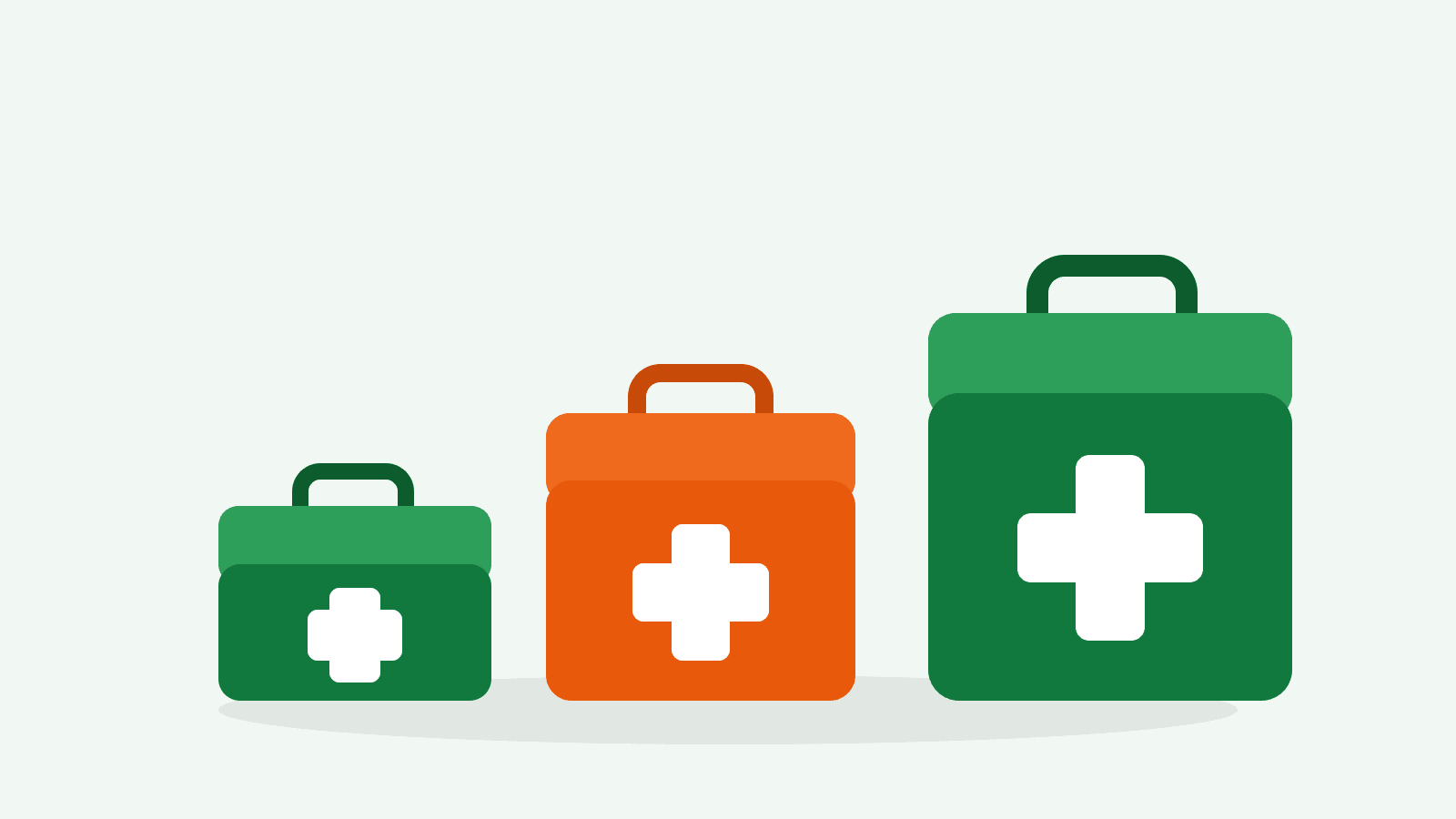
Kit A, Kit B and the emergency-response case: the difference
The distinction comes down to scale and use.
Kit B is the compact version: plasters, compresses, quick bandages and dressings in smaller quantities. It suits a small office, a shop or a company vehicle, where a handful of people work and the risk level is low.
Kit A contains the same categories of items, but in larger quantities and more variants. A common rule of thumb is a team of roughly 25 people or more, or an environment with a somewhat higher risk.
The BHV case (BHV is the Dutch term for company emergency response) usually builds on Kit A's contents and adds items specific to workplace emergency response: a rescue blanket, an incident card, extra gloves, and sometimes eyewash or burn care. What gets added should follow directly from the risks identified in your RI&E, for example extra burn gel in a kitchen or a tourniquet where sharp tools are used.
Choosing based on size and risk
Start from your risk assessment, not the price tag. Look at how many people are present at a location, including visitors, what kind of work happens there, and whether specific risks apply, such as heat, chemicals or sharp equipment. If you operate across multiple floors or sites, place a kit at each one so it is quick and easy to reach, rather than relying on a single case in a central spot. Hospitality and food handling often call for a HACCP version with detectable plasters and blue-coloured materials. Assign one or more emergency response officers to be responsible for checking the kit, so accountability does not get lost between people.
Maintenance is part of the job
Buying a kit is the starting point, not the end of it. Sterile items carry expiry dates, and anything used needs replacing. Check the contents regularly against the inventory list that comes with a proper kit, and make clear who owns that task.
At De Groene Koffer
Our range includes Kit A and Kit B first aid boxes, complete BHV cases and industry-specific versions such as HACCP, all put together according to the Het Oranje Kruis guideline. Not sure which one fits your team and risk profile? Start from your RI&E and choose from there, or ask us to think it through with you.